Mesić Monastery
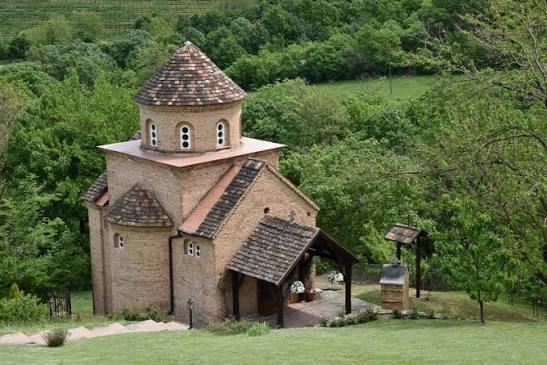
Mesić Monastery, nestled at the foot of the Vršac Mountains approximately 10 kilometres from Vršac, is one of the most significant Orthodox monasteries in the Banat region. Its history is closely associated with the medieval Branković dynasty, while its centuries-old frescoes and the revered icon of the Mother of God “It Is Truly Meet” are among its greatest treasures. Surrounded by forests and beautiful natural scenery, the monastery offers a peaceful setting for prayer, reflection and exploring the region’s rich cultural heritage.
Free admission – please confirm before visiting
The story of this place
Approximately 10 kilometres from Vršac, in the picturesque valley of the Mesić stream, surrounded by the wooded slopes of the Vršac Mountains, stands Mesić Monastery, one of the oldest and most important Orthodox monasteries in the Banat region. Dedicated to the Nativity of Saint John the Baptist, the monastery is a remarkable combination of spirituality, history, art and natural beauty. Its past spans centuries of destruction and reconstruction, while its present appearance reflects the rich cultural heritage of the Serbian people in southern Banat. A History Surrounded by Legends The exact date of the monastery's foundation remains uncertain. According to one tradition, it was established around 1030 by followers of the Slavic missionaries Saints Cyril and Methodius. Another tradition dates its foundation to 1225 and attributes it to Arsenije Bogdanović, a monk from Hilandar Monastery who is said to have arrived in the region with the blessing of Saint Sava. A more historically plausible interpretation connects the monastery's foundation or major reconstruction with the late 15th century and the Serbian noble Branković family, particularly Despot Jovan Branković and Bishop Maksim. The earliest known written references to the monastery appear in documents of the Patriarchate of Peć dating from 1660 and 1666. In later centuries, Mesić played an important role in the religious life of Banat and also served as a residence for the bishops of Vršac. Destruction and Reconstruction Through the Centuries Throughout its turbulent history, the monastery suffered repeated destruction, particularly during conflicts between the Ottoman and Habsburg Empires. Significant damage was recorded in 1716 and 1788, followed by reconstruction efforts supported by monks, church leaders and benefactors. During the 18th century, the monastery complex acquired a more representative appearance. A narthex and a Baroque bell tower were added to the church, while the surrounding buildings were adapted to the needs of monastic life. An earthquake in 1892 caused further damage to the church, but the complex was subsequently restored and preserved. Architecture and Precious Frescoes The monastery church represents an interesting combination of medieval Serbian architectural traditions and later Baroque influences. Its architecture reflects elements of the Raška and Morava schools, while the Baroque bell tower illustrates the artistic and architectural changes that influenced Banat during the 18th century. The monastery's wall paintings are of particular artistic importance. Inside the church, visitors can see surviving fragments of 17th-century frescoes alongside paintings from the 18th century, including works dating from 1743. These different layers of religious painting offer a fascinating insight into the development of Orthodox ecclesiastical art over several centuries. The monastery treasury also preserves valuable manuscripts, printed books and works associated with renowned artists such as Jovan Popović and Pavel Đurković. The Miraculous Icon of the Mother of God One of the monastery's most revered treasures is the icon of the Mother of God known as “It Is Truly Meet” (Axion Estin), displayed on the throne of the Virgin Mary inside the church. The icon is associated with the famous Athonite icon preserved in Karyes on Mount Athos and was brought to Mesić in 1803. Believers traditionally attribute miraculous powers to the icon and visit the monastery to pray for health, protection and spiritual comfort. Because of this sacred image, Mesić Monastery has become an important pilgrimage destination, attracting Orthodox Christians from Serbia and abroad. A Convent Since 1952 For centuries, Mesić functioned as a male monastery. In 1952, by decision of Bishop Visarion of Banat, it was transformed into a convent. Its first abbess was Mother Teodora Milošević, whose dedication contributed significantly to the restoration of the monastery buildings and the development of the religious community. Today, the monastery is maintained by a community of Orthodox nuns who continue the traditions of monastic life, daily prayers, religious services and the preservation of this important spiritual heritage. The monastery celebrates its patronal feast on 7 July, the Nativity of Saint John the Baptist, according to the Serbian Orthodox liturgical calendar. Nature and Tranquillity of the Vršac Mountains Beyond its historical and religious importance, Mesić Monastery attracts visitors with its beautiful natural surroundings. Located in a peaceful valley surrounded by green hills and forests, it offers a welcome escape from the noise and pace of everyday city life. The well-maintained monastery courtyard, traditional architecture and tranquillity of the surrounding landscape make it an excellent destination for a short excursion, a family visit or a relaxing stop while exploring the Vršac Mountains. Why Visit Mesić Monastery? A visit to Mesić Monastery offers an opportunity to discover fascinating chapters of Banat's history, admire valuable works of religious art and experience the atmosphere of one of the region's most important spiritual centres. Thanks to its proximity to Vršac, the monastery is easily accessible by car and can be included in a day trip featuring Vršac Tower, the Vršac Mountains and other local attractions. Mesić Monastery is more than a religious landmark – it is a living testament to the history, spirituality and cultural identity of Banat, preserved among the wooded slopes of the Vršac Mountains.
Photos
6 ukupnoFacilities and amenities
Reviews
How was your visit? Share your personal experience.
This place has no published reviews yet.
Questions and answers
Know something useful? Join in.
No published questions yet. Ask what you would like to know.
Explore more
Related categories for your next discovery.